The Journal
Patience is a Mountain
Notes on terroir, craftsmanship, and the silent art of Chaozhou tea.
The Terroir
Roots in Volcanic Rock
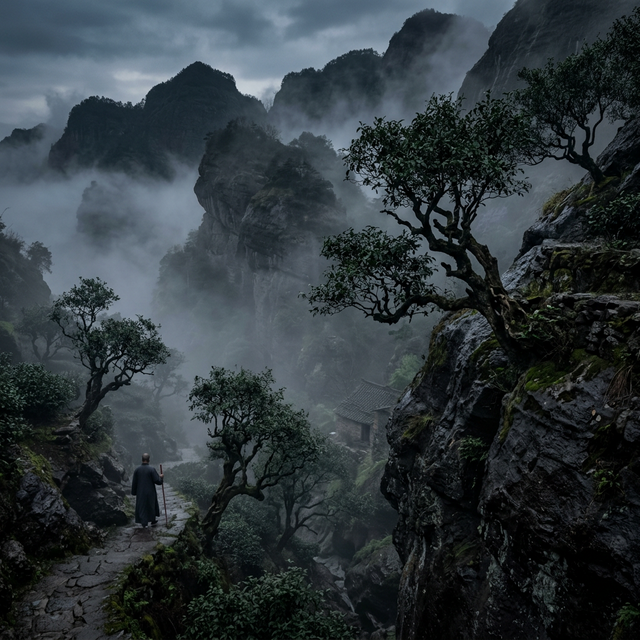
Wudong Mountain is not just an origin; it is an active participant in the flavor of every leaf. At 1,200 meters, clouds physically walk through the ancient tea gardens. The soil here is not dirt—it is weathered, mineral-rich volcanic rock.
This harsh environment forces the tea tree roots deep into the fissures of the stone. The result is 'Yan Yun' (岩韵) — a distinct mineral tension that grounds the high-flying floral aromatics of a true Phoenix Dancong.
Altitude
1,200m
Climate
Subtropical Monsoon
Soil
Volcanic Rock / Yellow-Red Earth
The Process
Thirty steps, one philosophy
采青
Plucking
Before dawn, at the peak of Wudong Mountain. Only the top bud and two leaves, only by hand.
5:00 AM · 1,200m altitude
晒青
Sun Withering
Spread thinly on bamboo trays under the mountain sun. The leaves lose moisture, soften, and begin their transformation.
Duration: 15–30 min
做青
Bruising
The master tosses and tumbles the leaves by hand, bruising the edges to trigger oxidation. This is where the aroma is born.
4–5 times · 8–12 hours
杀青
Kill-Green
A blast of high heat in a hand-operated iron wok arrests oxidation at exactly the right moment.
280°C · Wok-fired
揉捋
Rolling
The warm leaves are rolled into tight, twisted strips, concentrating flavor for future steeping.
Hand-rolled · 15–20 min
初烘
First Drying
A gentle initial drying to remove surface moisture and stabilize the leaf before the final trial.
Low heat · Bamboo baskets
炭焙
Charcoal Roasting
Over glowing lychee-wood charcoal, the master controls temperature entirely by feel. This slow fire takes weeks.
Lychee wood · 4–6 weeks
陈化
Aging
The finished tea rests in sealed clay vessels. Harsh edges soften, flavors deepen into 'chen yun' — the resonance of time.
3–12 months · Clay vessels
Trial by Fire
The Craft
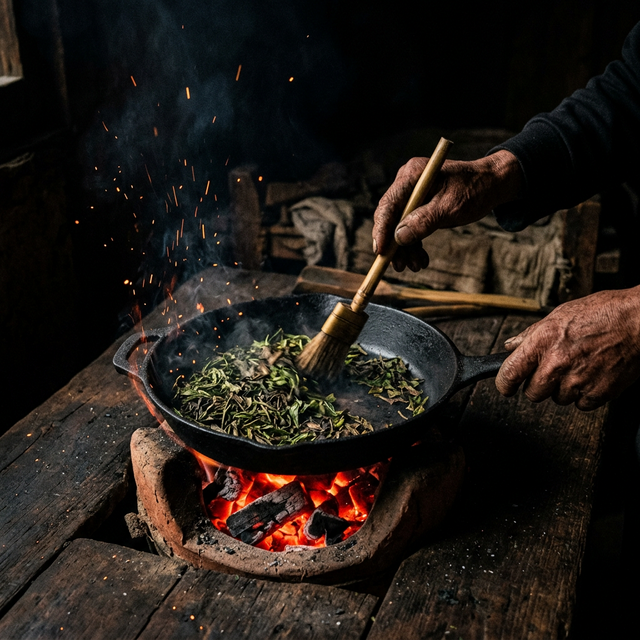
A machine can dry a leaf in minutes, but it cannot teach it how to age. In Phoenix Mountain, true Dancong is subjected to the ancient art of charcoal roasting (炭焙)—a slow, unforgiving process.
Over glowing lychee-wood embers, the tea master controls the temperature entirely by feel. Too hot, and the delicate floral notes burn away. Too cool, and the moisture remains, spoiling the tea within months. This delicate dance of fire and ash takes weeks, sometimes months, requiring sleepless nights and absolute presence. It is the ultimate expression of our philosophy: slowness is a luxury.
The Vessel
Clay and Water
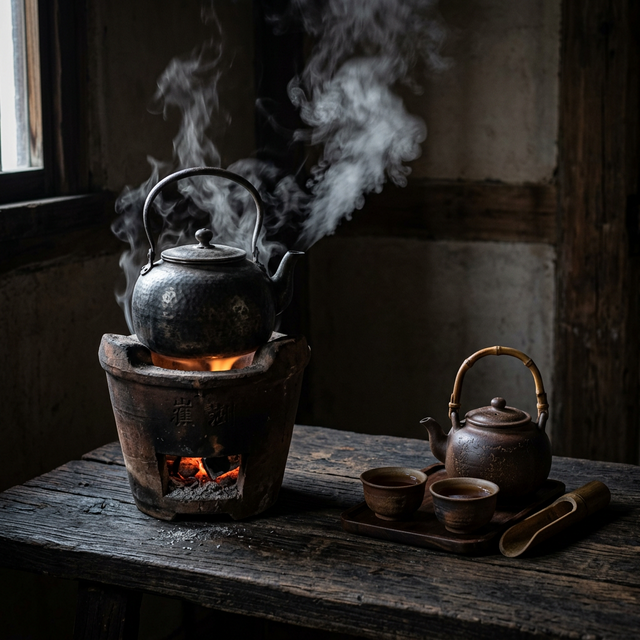
To brew Dancong in glass is to rob it of its soul. For hundreds of years, Chaozhou tea masters have relied on two specific tools: the porous red clay stove (红泥小火炉) and the dense, unglazed Yixing or Chaozhou clay teapot.
We prefer the gaiwan (盖碗) for its honesty—it absorbs nothing and hides nothing. But to truly round out the sharp edges of a young mountain tea, a well-seasoned clay pot will soften the water, elevating the texture from liquid to velvet.
Boil the water until it resembles 'crab eyes'. Wait for silence.